Phase Two
Setting Transit Priorites
Where should SunLine provide transit service in the region? People have told us very different, and sometimes opposite, things about what they want from transit. At the same time, SunLine has a limited budget. That means we can’t do everything at once, and we need your help to decide what matters most.
Earlier this year, we asked the community about their priorities for transit service through meetings and a survey. Based on what we heard, we drew two contrasting images of how the network could look within existing resource constraints under different priorities.
The Key Question
Should SunLine Focus on Ridership or Coverage?
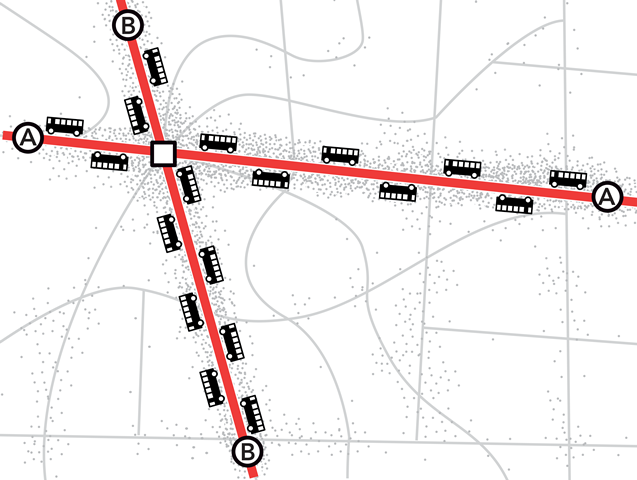
Ridership: Provide frequent, all-day service where the most people live and work. This makes transit more useful for more people and increases ridership, but some areas would have less service or none at all.
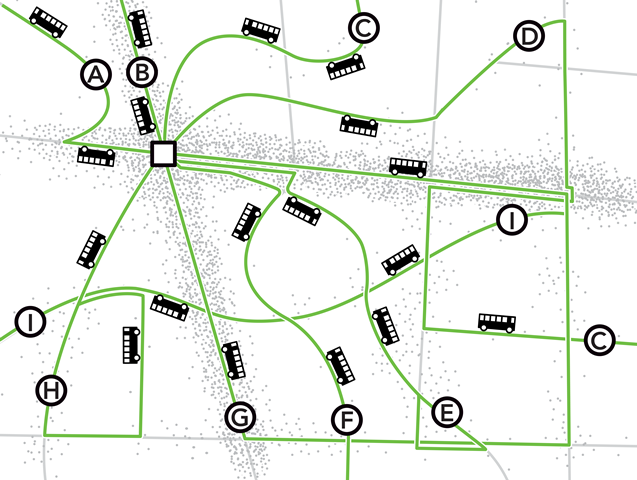
Coverage: Spread service so that more people have access to transit near where they live. This ensures broader access—but service would come less often, run fewer hours, and may be less useful for everyday travel.
Both concepts assume SunLine operates using its existing resources. Because we can’t add more service right now, we must make thoughtful choices about how to use what we have. Since these goals point in different directions, there are two main ways SunLine could design its transit network.
IMPORTANT: These network designs are not proposals! They’re examples to show what the network could look like under different priorities.
Explore the Network Designs
The maps below show two network designs that illustrate the ridership-coverage trade-off. When you look at these maps, notice the colors of route lines, which stand for frequencies (minutes between buses).
Red lines mean a frequency of 15 minutes or better in the middle of the day.
Blue lines mean about every 30 minutes.
Light Blue lines mean about every 60 minutes.
Tan lines mean this route operates very infrequently or during rush hours only.
Tan zones are demand response service areas.
Ridership Network
This concept focused on providing the best solution for bus service in the busiest parts of the region, with buses running every 15 minutes. Because service is frequent and timely, more people can reach more places more quickly, which leads to higher ridership.
However, this approach doesn’t work equally well for everyone. People living in lower-density areas may need to walk farther to reach a bus stop, and some areas may not have nearby service at all.
Move the slider to explore how transit service would change under the Ridership Network
View more detailed maps in your browser:
View what hours and days routes would run:
Coverage Network
This concept focused on expanding service to cover a larger area, so that more people have access to transit near where they live. It includes a combination of fixed bus routes and on-demand microtransit service (SunRide) that connect riders to key destinations or nearby routes.
Because service is spread across more routes and service areas, the available resources are stretched thinner. As a result, buses and on-demand services would run less frequently, with longer wait times. While more people would have access to transit, the longer waits and reduced frequency can make the system less convenient for everyday trips.
In this approach, fewer people may choose to use transit regularly, but it ensures that more neighborhoods maintain a basic level of access to transportation
Move the slider to explore how transit service would change under the Coverage Network
View more detailed maps in your browser:
View what hours and days routes would run:
| Ridership Network | Coverage Network |
|---|---|---|
Proximity to Transit |
|
|
Access to Opportunities |
|
|
Why Do We Have to Choose between Ridership and Coverage?
These two network designs showed the different ways we could redesign our network under different priorities, all within the same budget we have today.
Because we can’t do everything at once public input is essential in helping us decide what SunLine should prioritize. The feedback received on these concenpts directly shaped the Draft Network Plan, which is now available for the community to review as part of Phase 3.
Engagement
Phase 2 based on the conceptual designs and discussion on ridership vs coverage route options.
Between May and June 2026, we asked the community to review two transit network concepts—one focused on coverage and one on ridership. Nearly 800 people responded to the survey, providing valuable input that will help shape the draft transit network plan.